
Process automation and AI for businesses
Processes that run on their own. Teams focused on what matters.
We identify which processes in your company are worth automating, calculate their return, and implement them on the tools you already use. With a clear method and without stopping your operations.
Initial diagnostic with no commitment · Reply within 24–48 business hours

- Order received
- Data validated
- Invoice generated
- Customer notified
- Report updated
Hours recovered this month: 64 h. Illustrative example.
Companies already running automated processes
 PdG ClinicProbióticos
 Hera BeautyEstética avanzada
 Prime ColadaLavanderías autoservicio
 Quiropráctica VitalCentros quiroprácticos
 AlvatoLavado y cuidado de vehículos
 B2DLogística integral
 InversaServicios informáticos
 Locker24Consignas y taquillas
 Mussö TextilSector textil
 DorsiaClínica estética
01 The invisible cost
Your company already pays for not being automated. It just does not show up on any invoice.
-
Hours of copy and paste
Data moved by hand from email to ERP and from ERP to a spreadsheet.
-
Errors that cost money
A mistyped price, a duplicate invoice, an order that never ships.
-
Customers left waiting
Inquiries that take hours to answer because no one sees them in time.
The good news: most of these processes can be measured, prioritized, and automated.
Measure what it costs you →02 Automation by department
Start with the department that loses the most time.
-
Sales and CRM
Qualified leads captured and followed up without relying on anyone's memory.
- Automatic lead capture and registration
- Qualification and alert to sales
-
Customer service
Answers in minutes, 24/7, and your team only on what requires judgment.
- AI agent for order status
- Ticket classification and routing
-
Finance and administration
Invoices, collections, and reconciliations that process themselves.
- Supplier invoice reading
- Staged payment reminders
-
Human resources
Onboarding, absences, and employee questions without endless emails.
- Onboarding with automatic checklist
- Leave and absence management
-
Operations and logistics
Orders, stock, and incidents connected end to end.
- Email order to ERP
- Stock alerts and incidents
03 Applied AI
Artificial intelligence where it delivers return. And only there.
AI does not replace your team: it handles repetitive work and first-line responses so people can focus on what requires judgment.
-
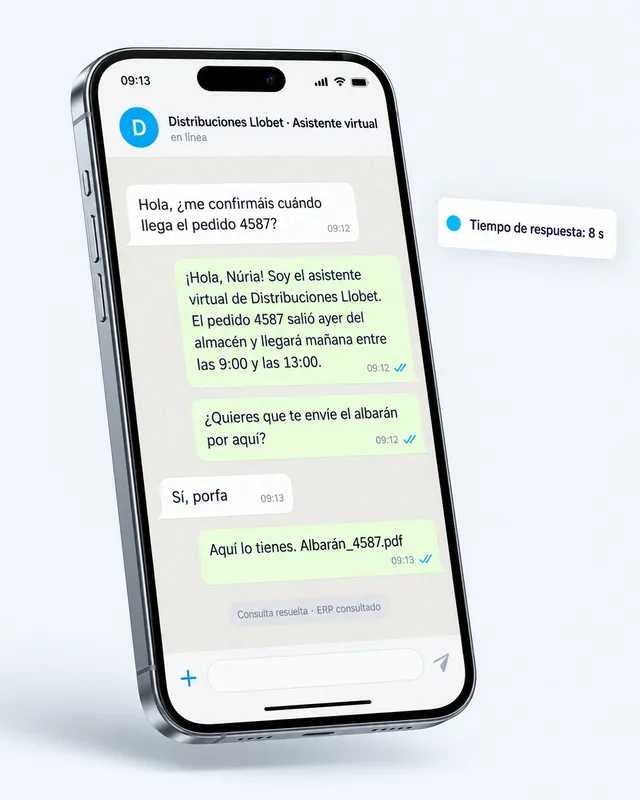
AI agents
They serve customers and suppliers on WhatsApp, web, or phone, query your systems, and act.
-
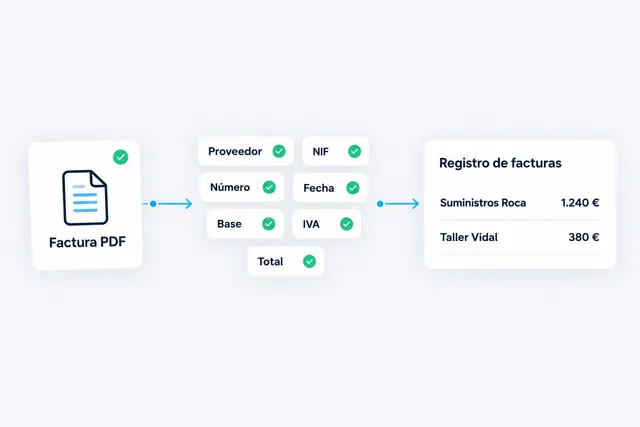
Document processing
Invoices, delivery notes, contracts, and résumés read, classified, and routed where they belong.
-

Internal assistant
Your team asks questions and gets answers based on your procedures and documentation.
04 Method
A five-phase method. No endless projects.
-
01
Diagnostic
We analyze how your company works and where time and money are lost.
-
02
Prioritized proposal
We present processes ranked by return, with savings and investment estimates.
-
03
First automation
We start with the highest-return process and get it running. From there, we scale.
-
04
Rollout
We extend it, train your team, and leave it running.
-
05
Continuous improvement
We monitor, support, and propose new automations.
06 Return calculator
How much is manual work costing you?
07 Integrations
We work on the tools you already use.
Do not see yours? If it can connect, we can almost certainly integrate it.
List of tools Octomate has integrated with.
- OpenAI
- HubSpot
- Google Sheets
- Zapier
- Gmail
- Claude
- Make
- Zendesk
- Google Workspace
- Mailchimp
- n8n
- Google Forms
- Personio
- Google Gemini
- Hootsuite
- GitHub
- Looker Studio
08 Security
Automating does not mean losing control.
-
Minimal, reviewable access
Each automation runs with just enough permissions, and they can be audited.
-
Traceability for every automated action
You know what was done, when, and from which data.
-
GDPR compliance
We process data as processor, under contract, using the tools you already use.
-
People in the loop for sensitive decisions
Repetitive work runs alone. What requires judgment is validated by someone on your team.
10 Resources
Before you decide, get informed.
11 Frequently asked questions
Frequently asked questions
What is business process automation?
Connecting tools and defining rules so repetitive tasks run on their own, with AI where information needs to be interpreted.
Which processes should be automated first?
Repetitive, frequent ones with clear rules that today cause errors or delays. In the diagnostic we prioritize them by return.
Do I have to change my tools?
Not necessarily. We work on what you already use and add new ones only when it makes sense.
Will AI replace my team?
No. It handles repetitive work and initial customer contact so your team can focus on higher-value tasks.
How long does a project take?
It depends on scope and process. We start with a first automation—the highest return—and we spell it out in the diagnostic.
How much does it cost?
Usually an initial setup and a monthly fee with maintenance, support, and improvements. We give you the exact amount after the diagnostic.
What if something fails?
We monitor systems and provide support to resolve incidents quickly.
Is it secure? Is it GDPR compliant?
Each automation is designed with minimal access, traceability, and people on sensitive decisions. Details are on the security and compliance page.
Let us talk about your processes, not technology.
In the diagnostic we review 2 or 3 processes with you and tell you, with numbers, which one to automate first.
Request your process diagnosticReply within 24–48 business hours